Monday, February 25, 2013

This old coat

Mimi languishes with Rodolfo at her bedside; Musetta waltzes; Colline bids his coat goodbye. Photos: Elise Bakketun

The music and plot of Puccini's La Bohème are so familiar that it's a little like going to Disneyland with your friends from summer camp. You practically want to hum "It's a Sad World After All."

So the challenge, in Seattle Opera's production, is to offset the on-stage misery; the young artists (writers, painters, singers) may be starving and freezing, but they're determined to get through yet another discontented winter. Spoiler alert: the sweet-natured seamstress Mimi--sung by soprano Elizabeth Caballero--doesn't make it to April, despite her friends' frantic, last-minute efforts. The stalwart Arthur Woodley even sells his beloved overcoat to buy medicine, to no avail.

The story of these passionate scamps isn't all about heartbreak, though. Paris in the 1890s was plenty raucous, full of bright colors and brazen sexuality, captured in director Tomer Zvulun's fresh staging (the sets came from St. Louis, the costumes were dusted off from Seattle Opera's 2006 Bohème). The courtesan Musetta, especially--soprano Norah Amselem--revels in being surrounded by a "scent of desire" in her delightful aria, "Quando m'en vo" (which also provided the tune for Della Reese's biggest hit, "Don't You Know," in 1959).

A good thing that the audience knows what's coming. This Bohème doesn't slow down to showcase the opera's big numbers; instead, it showers the audience with musical exclamation points and dramatic sparkles from beginning to end, posting Instagram pix of the Bohemians on the curtain and tweeting hashtag #allaboutmimi. 

Seattle Opera's General Director, Speight Jenkins, is retiring after three decades at the helm of an organization that has seen both lean and happy years. With a surefire winner like La Bohème, a full slate of ten performances performed by two casts, happy times. Especially with a $15 family matinee on March 10th.

This summer, a new Ring cycle will bring Wagner fans from around the world to Seattle. By then, the trustees will have selected Jenkins's successor, but there's not enough money left for his going-away party. Plans for a new production of Meistersinger have been scrapped, and upcoming seasons will be cut back from five to four productions.

One could ask whether there's a future for regional opera companies at all, given that New York's Metropolitan Opera now broadcasts every one of its operas, live-in-HD, into movie theaters around the country. But that really would be a sad, sad world.

A street photographer captures the Bohemian friends at a Paris café on Christmas Eve

Seattle Opera presents Puccini's La Bohème, through March 10th at McCaw Hall. Tickets online (at www.seattleopera.org) and at the box office, 321 Mercer St., 206-389-7676. 


Monday, January 14, 2013

Seattle's Cinderella season lives on

You won't see this Cinderella story at the Clink (you wouldn't have, even if the Hawks had made it past the Falcons), but Seattle Opera is staging La Cenerentola, Gioacchino Rossinni's delightful retelling of the Cinderella story, this month at McCaw, complete with wacky costumes, wicked stepsisters and half a dozen supportive rats.

The bright and lively production is a travelling road show, originally built for Houston but "owned" by no fewer than four opera international companies. It's almost like watching a fill-in-the-singers cartoon, with a cast of relatively inexpensive rising stars plugged into the principal roles. As a result, the production values often outshine the voices.

Most fun are the six "rats" with shiny noses and long, languid tails. performed by a nest of locally recruited dancers under the direction of a Spanish actor and choreographer, Xevi Dorca.

A young Italian maestro, Giacomo Sagripanti, was responsible for the music's sprightly pace, which I wish had been even sprightlier, especially in the languid first act. That said, Sunday's Karin Mushegain as Cinderella embodied an appropriately modest and reticent "Venus of the Ashes" right up to her triumphant declaration, "Non più mesta," ("No more housework!") she proclaims, only to be undone by the production's twist: it was all in her head.

If the melody of Non più mesta sounds familiar, it well should: it's a transposition for soprano of "Cessa di più resistere" from Barber of Seville (performed here quite stunningly two seasons ago by Lawrence Brownlee). What a scamp, that Rossini, stealing his own music! What a thieving magpie!

Seattle Opera presents La Cenerentola, through January 26th at McCaw Hall. Tickets online (at www.seattleopera.org) and at the box office, 321 Mercer St., 206-389-7676.

Seattle Opera photo by Elise Bakketun

Sunday, October 14, 2012

Free the prisoners!

Seattle Opera photo by Elise Bakketun

Beethoven's lone opera, Fidelio, returns to the Seattle Opera stage just in time for election season.

The contemporary staging emphasizes the modern-day relevance of this two-century-old story. After all, what could be more touching than the heroic story of a political prisoner and the loyal wife who comes to his rescue?

"I didn't plan it to happen in the election season," general director Speight Jenkins told a radio audience on KING FM, "but it's certainly not inappropriate to produce an opera about freedom from oppression during the political season."

The values behind Beethoven's rousing music--personal freedom, individual initiative, --resound with half the political spectrum. But then there's that chorus of prisoners, the 47 percent, opposed to the tyranny of the rich, who haven't lost faith that justice will be done, and whose liberation in the final scene is the purest expression of hope and joy in opera.

There's a tired, long-suffering bureaucrat, the jail-keeper Rocco; an ambitious, morally reprehensible jailer, Don Pizarro; an innocent prisoner, Floristan; and his spunky savior, Leonora, who disguises herself as a man (Fidelio) so she can gain access to the prison.

It was guest conductor who made the call to begin with the so-called Leonora III overture, which emphasizes the haunting, haunted melodies of a prisoner, rather than the one Beethoven himself decided on (the Leonora IV, or actual Fidelio overture). Dragged on forever in melancholy, it seemed, followed eventually by Beethoven's trademark resoluteness.

 Christine Libor, a radiant German soprano, portrays Leonore. So convincing is her disguise that the jailor's daughter falls in love with her assumed persona. Rescue Floristan she does, of course, and justice triumphs. The prisoners are freed, the bad guy is led away, and the chorus (under guest chorusmaster John Keene) chants righteously that love conquers all.

Beethoven is the master of the uplifting chorale, the closing chorus of the Ninth Symphony, set to Schiller's lyric "Ode to Joy" being unequalled, but the prisoners' joyful "Heil sei dem Tag" (Praised be this day) in the second act of Fidelio sure comes close.

"It's like going to church," bass Greer Grimsley told an interviewer. You don't know whether to stand and applaud or kneel and pray.


Seattle Opera presents Fidelio, through October 27th at McCaw Hall. Tickets $25 to $225, online at www.seattleopera.org or by phone at 206.389.7676 or 800.426.1619.

Tuesday, October 9, 2012

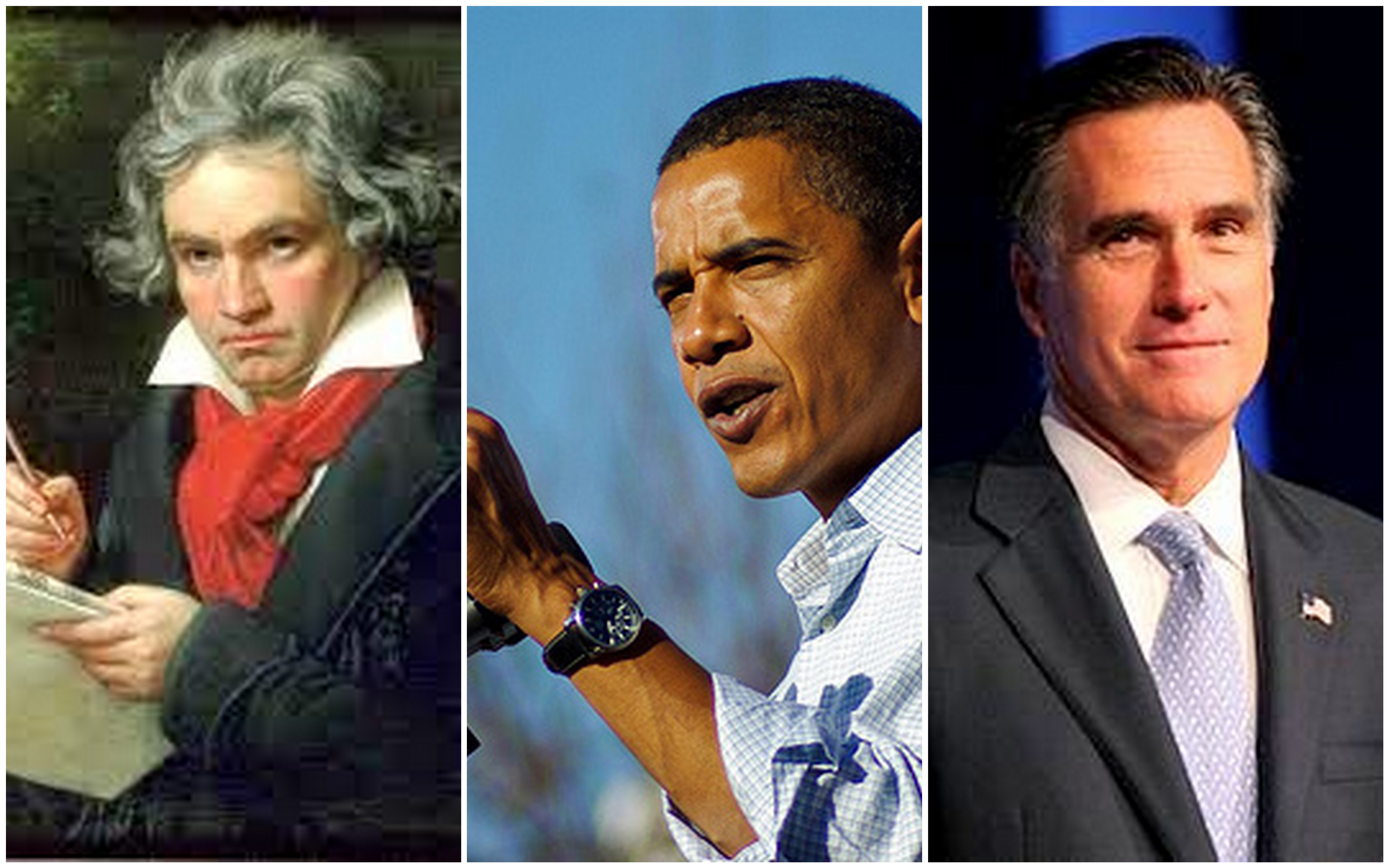
Ludwig, Barack & Willard walk into an opera house

Desktop1.jpg Seattle Opera rolls out Beethoven's lone opera, Fidelio, once every decade or so, most often in a contemporary staging that emphasizes the modern-day relevance of this two-century-old story. After all, what could be more touching than the heroic story of a political prisoner and the loyal wife who comes to his rescue?

"I didn't plan it to happen in the election season," general director Speight Jenkins told a radio audience on KING FM this weekend, "but it's certainly not inappropriate to produce an opera about freedom from oppression during the political season."

The values behind Beethoven's rousing music--personal freedom, individual initiative, --resound with half the political spectrum. But then there's that chorus of prisoners, the 47 percent, opposed to the tyranny of the rich, who haven't lost faith that justice will be done, and whose liberation in the final scene is the purest expression of hope and joy in opera.

There's a neutral, long-suffering bureaucrat, the jail-keeper Rocco; an ambitious, morally reprehensible jailer, Don Pizarro; an untarnished nobleman, Don Fernando; an innocent prisoner, Floristan; and his spunky savior, Leonora, who disguises herself as a man (Fidelio) so she can gain access to the prison.

The challenge faced by Seattle Opera is to take a story in what's become an elitist art form (but which, in its day, was even more populist and culturally relevant than rock concerts) and reconnect it with the local audience. Hence this project, last month, for a commnity sing-along of the Prisoners Chorus.

Seattle Opera presents Fidelio, October 13-27 at McCaw Hall. Tickets $25 to $225, online at www.seattleopera.org or by phone at 206.389.7676 or 800.426.1619.

Tuesday, July 31, 2012

Silent but Mighty: Movies at Paramount


Sitting at the organ console below the screen at the Paramount Theater is Jim Riggs, a mild-mannered Midwestern music teacher whose calling is to accompany silent film screenings across the country. His favorite instruments are the enormous organs built by Wurlitzer in the heyday of silent movies, 80-plus years ago, invariably referred to as "Mighty Wurlitzers." (There's a local non-profit devoted to the restoration of the Wurlitzer in Seattle.) Riggs improvises melodies as he watches the on-screen action, accenting the visuals with warbles, trills, clangs, and sighs. Last night it was Cecil B. DeMille's 1927 epic "King of Kings," which mixed interludes of reverence (it's Jesus, after all) and villainy (the money changers), grandeur (the Temple) and playfulness (goats, children). DeMille's casting included an Austrian matinee idol named Joseph Schildkraut as the turncoat Judas Iscariot (I couldn't help flashing forward by three decades to Schildkraut's turn as Anne Frank's father); cowboy star H.B. Warner plays an exceedingly well-coiffed Jesus. 

All this was the final installment in the 2012 season of Trader Joe's "Silent Movie Mondays," which resume next May. Seattle, says organist Riggs, is a great silent movie town.

Wednesday, June 13, 2012

More Cafe Nordo? Yes, Please!

Cafe Nordo, the imaginative, even zany pop-up restaurant and dinner theater, has extended its current run of "Cabinet of Curiosities" through June 23rd. It's a look at the history of food, with an emphasis on poisonous mushrooms, immortal vegetables, and mysterious soups.

Under the aegis of the imaginary "Chef Nordo Lefesczki" patrons are served three appetizer courses in lavishly decorated rooms of Capitol Hill's venerable Washington Hall, (a French Salon, a cave of Invasive vegetables, a magician's parlor) before the main banquet is served. Lefesczki himself remains aloof, but is represented by his creative alter egos, the impresarios Erin Brindley and Terry Podgorski, along with an able staff of guides and actors (who double as waiters),

The four-hour, five-course performance is filling and satisfying, both gastronomically (Painted Hills filet, Wilson Fish king salmon) and artistically, Details at www.cafenordo.com; reservations via Brown Paper Tickets

Podgorski, a Circus Contraption alumnus, tells Cornichon that the next Cafe Nordo, this fall, will be at a venue in the International District. "We're not like Teatro Zinzanni, with a permanent location, because that would spoil the secret, the exclusivity. We do two shows a year with a capacity of maybe 1,200 people. You have to be in the know."

Friday, May 11, 2012

Butterfly's tragic tale of trust & betrayal

Seattle Opera photo by Elise Bakketun
The story is straightforward, as grand opera plots go: a naval officer deceives a poor young girl and pretend-marries her, gets her pregnant and leaves town. When she learns, three years later, that he has for-real married someone else, she turns the child over to his new wife and kills herself.

In Madama Butterfly, currently playing at Seattle Opera, this age-old tale of wayward love, of trust and betrayal, is set in Japan (a new and exotic land to early 20th century Europeans), but Puccini's music and the Giacosa-Illica libretto were written for Italian ears: over two hours of nonstop, romantic arias, duets and interludes swirling inexorably toward the Butterfly's inevitable, tragic ending.

The term "cad" may be old-fashioned, but Butterfly's lover, Lieutenant Benjamin Franklin Pinkerton, is nothing less. Though he woos her well, in a magnificent love duet that ends Act One, he never considers her more than a plaything. Much is made of his "America Forever" sense of entitlement to "pluck the flowers on every shore" he visits. The US Consul, Sharpless, warns him about not to break Butterfly's "trusting heart," but Pinkerton has convinced himself that in Japan, "everything is flexible," even a marriage contract.

Poor Butterfly. When she enters with her bridal party, luminous beneath a golden parasol, she is "the happiest girl in Japan." She gives herself completely to Pinkerton, even though she's promptly renounced by her family. At the beginning of Act Two, abandoned for three years, she still waits for Pinkerton's ship to return. And here, at Madama Butterfly's midpoint, comes "Un Bel Di," the opera's most famous aria, the heroine's gut-wrenching resolve to tough it out, come what may. Alas, as we know all to well, It's all downhill from there.

When Pinkerton does return, he can't even face Butterfly. Too late, he realizes what a shit he's been. Too late, Butterfly acknowledges she's been deceived. "I knew it would end like this," clucks the Consul. (Last year, an American professor wrote a book, "Butterfly's Child"--renamed Benji-- that imagines the youngster growing up \on a farm in the Midwest after Pinkerton retires.) Stefano Secco, the tenor from Milan who sings Pinkerton in this production, says he knows he's done a good job when he gets booed at the curtain call.

But in the end, it's all about the soprano who sings Butterfly. Patricia Racette owns the role, taking us from a giddy teenager thrilled to be marrying an American in a Navy uniform to the sadder but wiser single mom who chooses suicide over dishonor. Racette has lived in Japan and knows firsthand the gestures and movements of a geisha; she has sung Butterfly almost 100 times, most recently at the Met in New York. Vocally, the part demands everything, while physically the Japanese geisha gestures must be precise. If there's an emotion to be manipulated, Racette knows how to wring the heartstrings.

The story, in fact, was originally adapted for the Broadway stage by the American playwright David Belasco; Puccini saw a production in London in 1900 and--though he understood not one word of English--was moved to tears. And, sure, there's a certain irony that in Seattle the American naval officer is sung by an Italian, the American consul by a Canadian, the two Japanese women by Americans, all led by a Bulgarian conductor. If you stood around until the world produced a perfect Japanese Butterfly, you'd still be waiting for the downbeat.

On the HD simulcast at Key Arena on opening night, it was a bit of a surprise to see beer vendors in the aisles before the music started, although there was no intrusive "Getcher programs, getcher peanuts, getcher sooshee!" thank goodness.Instead, the jaw-dropping immediacy of the performace itself. I found that the closeups of the singers made the story seem even more tragic, but my own sense of awe and terror wasn't readily shared. (That essay is here.) Onstage at McCaw, there seemed to be much greater warmth in the audience toward the performers, a greater connection with the artists, and a growing sense of excitement and foreboding that exploded in well-deserved applause at the final curtain.

Seattle Opera presents Madama Butterfly, at McCaw Hall. Performances May 11, 12, 16 & 19 at 7:30 PM; May 13 & 20 at 2 PM. Tickets from ($25 to $244) online at www.SeattleOpera.org, or by calling the box office (206-389-7676) during business hours.

Above: Patricia Racette as Butterfly, Sefano Secco as Pinkerton.