Monday, January 17, 2011

The Bachelor of Seville

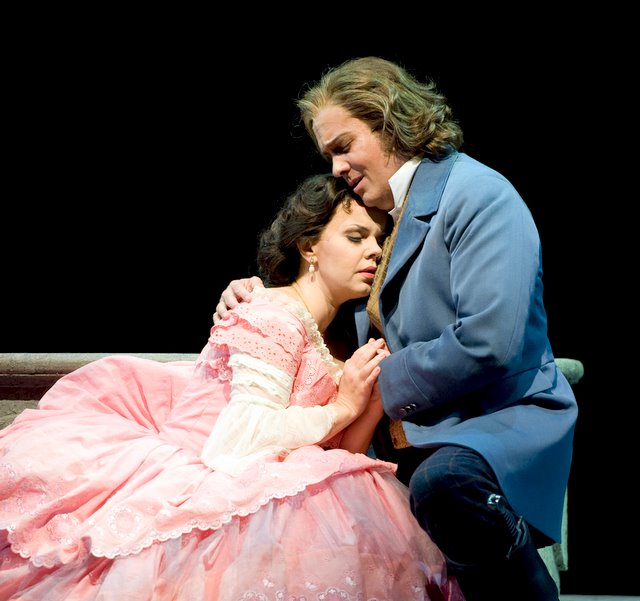
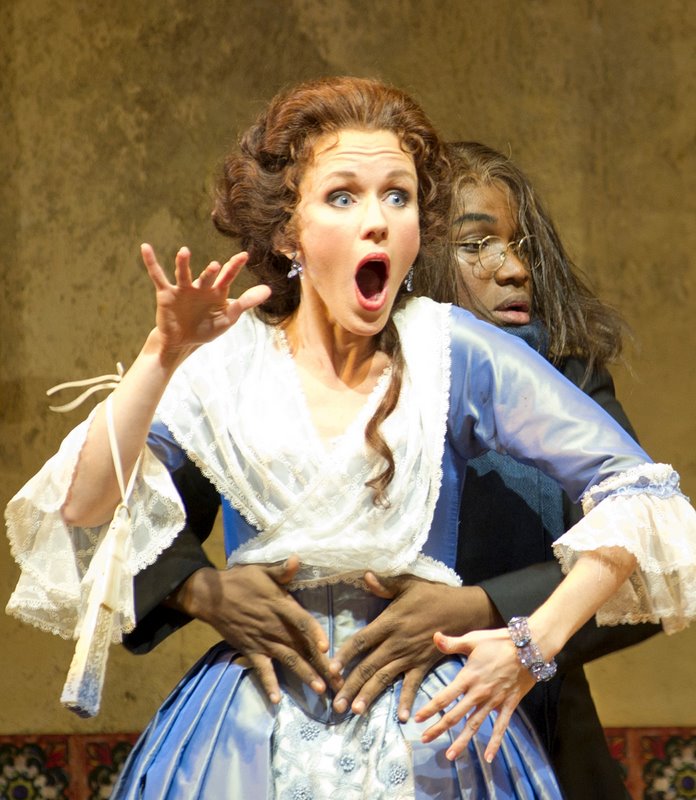
Coburn w Brownlee.jpgOkay, last week we were fooling around in the lobby with The Barber of McCaw. This week it's time to get serious with a rollicking show that could be called "The Bachelor of Seville."

The more-than-suitable suitor is Count Almaviva. The rose? Technically, it doesn't show up until Rosenkavalier a full century later, where it's pure invention on the part of Richard Strauss. We have to make do, in Gioachino Rossini's hilarious opera, with the notion of a romantic serenade. The commedia dell'arte genre requires a collection of stock figures: a young hero, a beautiful heroine, an old meddler, a dashing soldier, and so on. Youth versus age, servants versus masters, women versus men. Rossini, not yet 24 when Barber premiered, was clearly on the side of the newcomers, the subjugated, the females.

Figaro, well, he's the barber at a time when barbers did a bit of everything, from shaves & haircuts to bloodletting to mailing letters. A Fixer, if you will, or, in the Seattle Opera staging of the piece, a combination reality show host, field producer and location manager.

And lest we forget, there's a hefty element of "American Idol" here as well. Each of the characters is called upon to sing an aria (or two) designed to showcase their best stuff. In the Saturday cast, Lawrence Brownlee blew the field away with a dazzling and rarely performed aria at the end of the opera, "Cessa di più resistere, Resistance is futile."

The two Rosinas, Sarah Coburn and Kate Lindsey, do their best as well with duelling versions of Una Voce Poco Fa, a sort of "Dear Diary" that starts with dreamy thoughts of the man behind the voice that has just serenaded her, then digresses into a headstrong "my guardian's not going to push me around" fantasy.

Every character lives in a fantasy, it turns out. Figaro thinks he's a sought-after big shot capable of fixing anything; Almaviva thinks he's irresistible (he serenades the audience, not his beloved); the doddering Bartolo thinks he's reasonable and charming; Basilio spins empty-headed evil plans of slander. Only the housemaid Berta knows the truth, that the cruel march of time is threatening to leave her an old maid. Sally Wolf, who sings this part, has the vocal chops to play leading roles; in fact, she's a semi-retired diva with a long list of starring credits. Far from being wasted in a minor role, she reminds us of what depth Seattle Opera has when it comes to casting its supporting singers.

Dean Williamson does double-duty in the pit, keeping up the frenetic orchestral pace and playing the fortepiano during the recitatives as well. Peter Kazaras had the pleasure of directing many of his former Young Artist Program performers and resisted the temptation to turn Barber into slapstick, with the notable exception of the first half closer. Seriously, colliding robots? Bachelor, I mean Barber, is plenty funny without another layer of artifice.

In the end, of course, love conquers all, Rosina graciously acccepts Almaviva's figurative rose, and even the bad guys are accorded a measure of respect. It's an opera without a mean bone in its body, The Barber of Civility, if you will.

Seattle Opera presents Gioachino Rossini's Barber of Seville, through Janusary 29 at McCaw Hall, 321 Mercer Street, Seattle. Tickets cost $25 to $208; during a Family Day matinee on Jan. 23, up to four $15 student tickets can be purchased with one full-price ticket. Tickets are available by phone (206-389-7676), at the box office (1020 John St., Seattle), or online.


Photo: Soprano Sarah Coburn with tenor Lawrence Brownlee, Seattle Opera photo © Rosarii Lynch

Saturday, December 18, 2010

La Scala: Opera Outside the Box

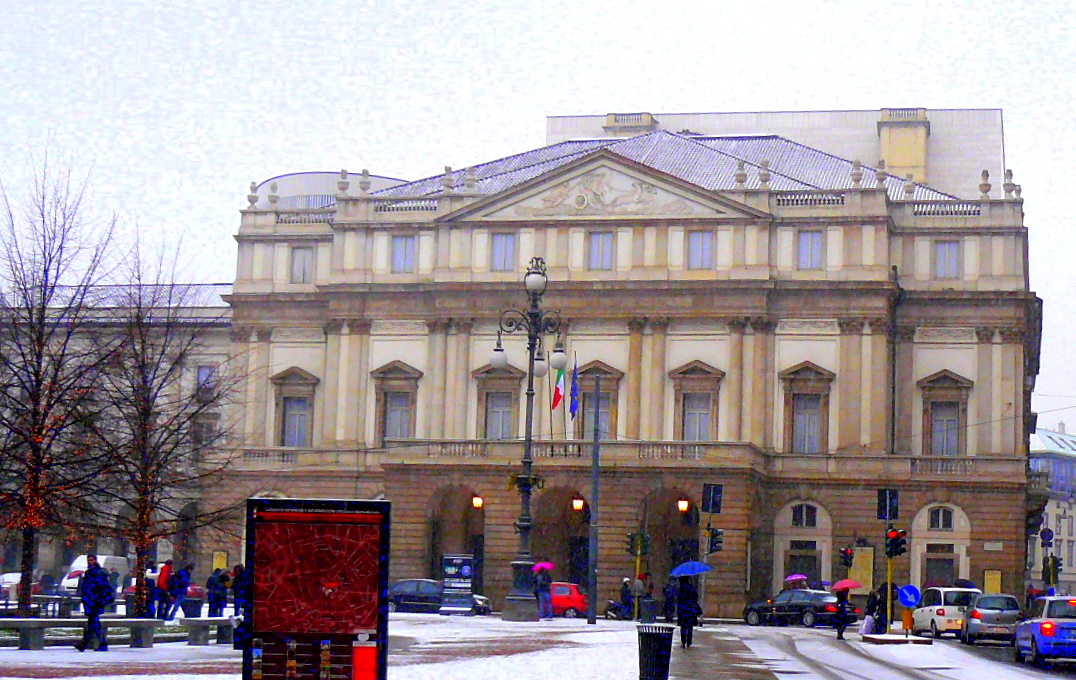
La Scala.JPG

MILAN--It may not be as grand, lavish and ornate as, say, the Opéra Garnier in Paris (built in the Napoleonic style 100 years later), but the Teatro alla Scala--after two years of technical remodeling and interior refurbishing--has returned to the summit of the world's great opera houses.

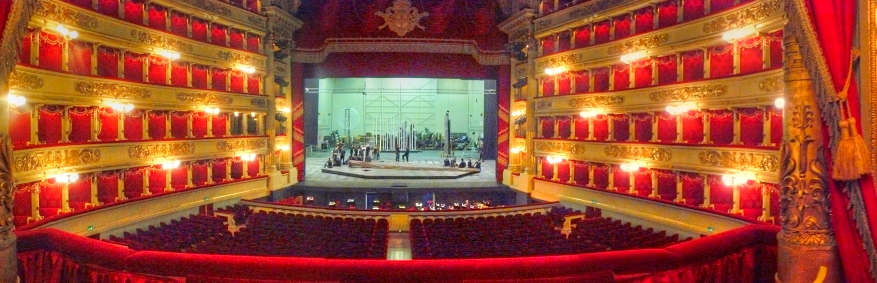
La Scala interior_tonemapped.jpg

Built in 1778, La Scala today seats some 2,030 opera-goers, starting with rows and rows of burgundy-colored seats on the ground floor. A video display on the seatback shows the dialog, in the language of the singers and in a choice of Italian or English. You can see (in the bootlegged panorama taken surreptitiously from the Royal Box) that a giant black rectangle for supratitles, like the ones projected in Seattle and New York, simply would not work here. You can also see stagehands assembling the set for the current production of Wagner's Die Walkürie ; dem's da flying horses in the very back of the stage (almost 18,000 square feet of space, enough for three or four complete sets; traps to a depth of 60 feet, flies to a height of 120 feet).

Then four levels of plush red boxes, 36 on each level. At the center, the boxes seat six; as they get closer to the stage (with poorer views), five seats, then four. The boxes were once owned by local families who even had private kitchens in the arrière-loge , but today the seats are sold individually, top price (240 euros, $350!!) for the front spots, less for the back. At the top of the house, two levels of "galleries," supposedly standing room, with the last 140 second-row seats going on sale nightly for 10 euros. (See Cornichon's previous entry, Postcard from Milan for details.) They're standing-room seats if you want to see anything; there's actually a chair if all you want to do is listen.

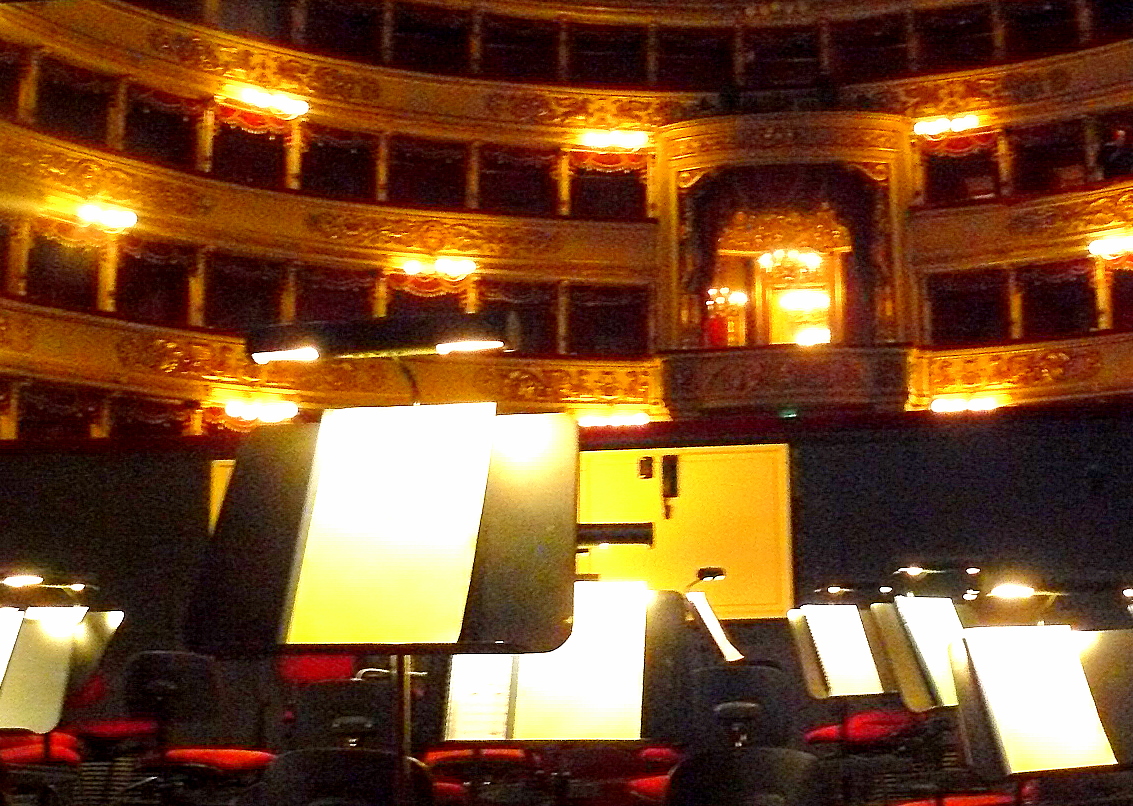
La Scala orchestra pit.JPGAnd what do you hear? The best acoustics imaginable and the largest orchestra pit in Europe, 25 feet deep, with a pine floor that maximizes the sound of 110 musicians. (A great view of the Royal Box, too, if you're not concentrating on the conductor or your score.) Singers have to project over that abyss; it's no wonder that it's virtually impossible to sing at La Scala for one's entire career. And the standees, the reguars who hang out in the gallery, they know what's what. They hooted Roberto Alagna off the stage one night, propelling his understudy, Antonello Palombi, into the production of Aida wearing street clothes. (There's a Seattle connection, by the way. Palombi arrived at McCaw Hall a few weeks later to sing the lead in Pagliacci; Cornichon's reviews are here and here.)

The new La Scala is so technically proficient that it is able to present over 270 performances a year, 70 percent more than before the remodeling project. That's good news to opera lovers here (and La Scala has its share of locals who attend virtually every performance). It's also good news to the administration, which needs those box office receipts. Attendance is strong, running at well over 90 percent capacity. Altogether, an enviable position for an opera house.that's been around for 200 years.

One last note: La Scala was the first public building in Europe to be illuminated by electricity. Today, the chandelier alone has nearly 400 bulbs; the monthly electric bill is close to $200,000.

Sunday, October 17, 2010

Lucia's Bright, Shining Madness

Lucia w Edgardo.jpgThe first of several heart-stopping moments in Seattle Opera's dazzling new production of Gaetano Donizetti's Lucia di Lammermoor comes in the first act. Lucia, sung with crystalline brilliance by the Polish soprano Aleksandra Kurzak, entwines her limbs with Edgardo's (tenor William Burden) as they pledge eternal love. In the audience, you can't help but fall in love with the singers, even though you know there's trouble ahead, big trouble.

Meanwhile, the music keeps on coming. When Lucia premiered in 1835, Donizetti was the king of Italian opera composers, with Rossini retired, Bellini dead, and Verdi still on the horizon. For continental audiences of the 19th century, the Scotland of Sir Walter Scott's romantic novels was a wild and woolly emotional frontier of stormy landscapes dotted with rugged cliffside castles and populated by endlessly warring clans. (For all that, the setting of this Lucia is more Italian hill-town than craggy Lammermuir.) In the second act, there's a brilliant sextet in which the principle characters express their individual perspectives on the action (joy, despair, trepidation, excitement, etc.) in what's become an operatic clické, but here it's staged with such musical conviction that you realize "Aha! This is where those silly parodies (Bugs Bunny, Three Stooges), originate! Now they make sense!"

Then, in the third act, comes the hair-curling mad scene, which could be nothing but coloratura flash. With the right performers (Maria Callas, Dame Joan Sutherland), it becomes a gut-wrenching tour de force. (The opening night performance was dedicated to Sutherland's memory.) Kurzak is technically perfect and emotionally convincing.

The Seattle Opera chorus periodically fills Robert Dahlstrom's multi-tiered set with lavish costumes (by Deborah Trout) and rousing voices (prepared by Beth Kirchhoff). In the pit, the Neapolitan conductor Bruno Cinquegrani, a Donizetti specialist, leads the orchestra with assurance and verve.

It's the fourth time now that McCaw audiences have heard Burden: shipwrecked in Iphigenia auf Tauris, shirtless in Pearl Fishers, in dress whites as Amelia's father, and now as a love-struck Scotsman. He becomes more assured and muically confident with each appearance. If he kept his mind on his mission (avenging his family, murdered by Lucia's older brother) there'd be no opera. If Lucia refused hers (to marry her brother's benefactor), there'd be no opera. Instead, Lucia kills her husband,goes mad and kills herself. Burden has the unenviable task of following one of the most famous scenes in opera with an anguished aria of his own; he pulls it off with aplomb.

Kurzak, an immensely talented and accomplished lyric soprano whose roles to date have stopped just short of madness, sings her first Lucia. She's entirely credible as a teenage Lucia (clowning around a fountain) who quickly gets in over her head as a pawn in story's medieval Scottish politics. She lands the thrilling high notes but she's almost too cute for her hysteria to be absorbed as tragedy. Genuine madness, you think, requires greater maturity, greater sense of loss than teenage poutiness:
Act One: @LuciaLamm Edgardo the coolest, love forever, but bro disapproves
Act Two: @LuciaLamm Marry to save famiily, WTF? Arturo better not eff w me
Act Three: @LuciaLamm OMG stabbed Arturo blood everywhere. Losing it

And yet, and yet. What makes Lucia such a pleasure is the seamless collaboration of international talents (Polish, Croatian, Italian, Israeli, Spanish, to name just the froeign-born artists) in the service of music written close to 200 years ago, music that gives a depth of meaning to a timeless story, performed by singers who give it emotional depth.

Sopranos (and the occasional mezzo) go mad with frightening regularity in opera; on this same stage we've heard Elvira in I Puritani, the title character in Amelia, Lady Macbeth in Macbeth (more histrionics), and Azucena in Il Trovatore

So when Kurzak's Lucia descends the staircase of the Piranesi-inspired set clutching the bloody veil of her wedding gown, she's no longer a little girl overwhelmed by family politics, she's no longer a "canary" but a woman with spectacular vocal gifts. Her madness, transcending demented confusion, becomes an expression of victory, of moral clarity.
Un armonia celeste, di, non ascolti?
That celestial harmony, don't you hear it?

What we learn from Lucia is an all-too-familiar lesson: sanity is no substitute for honesty, madness no impediment to truth.

Seattle Opera presents Lucia di Lammermoor at McCaw Hall through Oct. 30th. Tickets $25 to $191. Reservations online or by calling 206-389-7676.

Seattle Opera photos © Rosarii Lynch