Sunday, January 15, 2012

Attila invades Seattle Opera

 
Giuseppe Verdi was only 33 when Attila had its premiere (in Venice, in 1846), and he had already written the wildly popular Nabucco, an opera whose "Va, Pensiero" (the Chorus of the Hebrew Slaves) would become the anthem for a united Italy in 1861. He would write another 19 operas after Attila, almost all of them grander and more mature works, most with similar themes; Verdi's particular gift was music that intertwined the power of politics and the drama of human emotions.

Opera in the 19th century was accessible to virtually everyone serving as an influential means of civic communications, not unlike rock concerts today, and Attila (pronounced, in the Italian idiom, AH-till-uh) celebrates nationalistic resolve against a foreign invader.

In the title role, John Relyea struts around the stage in camouflage fatigues and a fur-lined Mongolian greatcoat, his menacing bass notes booming like cannon fire. Fresh from La Scala, baritone Marco Vratogna reprises the part of Ezio, the Roman ambassador who tries to appease the bloodthirsty Huns. Barrel-chested Antonello Palombi has the full-throttled tenor role of Foresto, leader of the rebels, and it is the Venezuelan soprano Ana Lucrecia Garcia who outshines them all, vocally and dramatically, as the daughter of a slain rebel who avenges her father at the final curtain.

Garcia & Palombi.jpgBudget cuts may mean there's no longer a complete "second cast," and only one Sunday matinee of Attila, yet, even if the production looks a bit drab, Seattle Opera hasn't skimped on singers or music. The remarkable chorus, directed by the admirable Beth Kirchhoff, is divided here into Huns, slave women and refugees, and Verdi gives them several rousing ensembles. Carlo Montanaro, who conducted Don Quixote in Seattle last season, returns to lead the orchestra with impressive respect for Verdi's score.


Alas, the French stage director, Bernard Uzan, can do no more than shuffle the singers around the imported set, enhanced for the occasion with digital rearscreen projections that successfully disguise urban rubble as a forest glen, but are otherwise irrelevant (a map of Italy, a stencilled eagle, a symbolic A for Attila). Melanie Taylor Burgess's costumes are the most puzzling aspect of this production: the Huns wear standard-issue guerilla denim, but refugees wear what look like royal blue silks and satins, Foresto gets an elegant, full-length leather coat; the Roman ambassador wears a silly, gold-braided, bright-red soldier-suit; a priest (the Pope?) wears dazzling white vestments. Ms. Garcia suffers the indignity of a costume that's a cross between Mao suit and a stewardess uniform.

Ezio's first-act offer to Attila, "Avrai tu l'universo, resti l'Italia a me!" ("You can have the universe, but leave Italy to me!") may sound like treasonous Realpolitik today but resonated as patriotism to Italian audiences of the day. By removing all traces of historical context and dressing Attila in a rag-tag mash-up of contemporary freedom-fighters, Seattle Opera has done itself no artistic favors. In the end, however, it is the magnificent singing that raises this Attlia above the level of guerilla theater.

Seattle Opera presents Attila by Giuseppe Verdi, at McCaw Hall through January 28th. Tickets $25 to $213 online or by calling 800-426-1619


Seattle Opera photos of John Relyea in the title role, top, and Ana Lucrecia Garcia with Antonello Palombi, above © Elise Bakketun

Friday, September 16, 2011

Johsel Namkung's Remarkable Nature Photographs

Josel Namkung with his 1981 photograph "Lake Juliuis, North Cascades"
The current exhibit at the Gordon Woodside / John Braseth Gallery in South Lake Union, titled "Masters Behind the Lens," features works by Ansel Adams and Johsel Namkung.

Adams is represented by a framed group of six familiar black and white prints, offered at $200,000. Far more interesting are the dozen or so vivid color prints by the 92-year-old photographer Johsel Namkung, selling for $5,500 apiece. It's as good a show as one can find outside a museum; in fact, the last time these photographs were exhibited was in 2006 at the Seattle Art Museum.

Namkung is a remarkable polymath. Born in Korea to a Chinese family that converted to Christianity, he studied music in Japan. In 1940, as an apiring opera singer, he took first prize in the All-Japan Music Contest. After the war, he and his wife, Mineko, moved to Seattle, where Johsel earned a master's degree in music at the University of Washington. Because he spoke several Asian languages fluently, he was then hired by Northwest Orient Airlines, but he soon discovered photography and embarked on a series of apprenticeships with the likes of George Tsutakawa, Paul Horiuchi, Mark Tobey and Ansel Adams himself. At one point in the 1950s, during the simmering conflict between North and South Korea, the Namkungs were declared enemy aliens and slated for deportation. Mineko, for a time, worked as a kimono-clad waitress at Canlis to help pay the family's legal bills.

To support his burgeoning career as an artist, Namkuing took a position as a scientific photographer with the UW School of Medicine. A friend gave him $500 to buy a Sinar 4 x 5-inch view camera and several lenses, which he used for his nature photography for the next three decades. In his book, "Ode to the Earth" (pbulished by Cosgrove Editions in 2006) Namkung describes "the loneliness and exultation" of reaching the top of the mountain, "standing all by yourself with your camera."

The actual printmaking is done by Namkung's longtime collaborator Dick Busher, who first scans the negative into a digital file. Namkung orchestrates the balance of colors (tone, hue and density), then Busher makes a proof using a highly calibrated Epson color printer fed by a 44-inch-wide roll of cotton-based, archival paper. The process uses eight inks and takes over two hours for each print.

The results are astonishingly textured, almost painterly images, from closeups of an icicle to a telephoto frame of heather on a mountainside. They make you gasp with wonder.

The exhibit runs through October 15th and is free. Woodside/Braseth, 2101 9th Ave., 206-622-7243, www.woodsidebrasethgallery.com. Open 11 am-6 pm Tuesday-Saturday.

Tuesday, August 2, 2011

A Lush Porgy and Bess at Seattle Opera

Jacob Gershovitz was born in Brooklyn at the end of the 19th century, the son of Russian Jews. Like Mozart, he died young; like Puccini, he wrote music that effortlessly assimilated the melodies and styles of other cultures. Like so many first-generation Americans, he was fiercely proud of the country his parents had adopted. (In that regard, he was rivaled only by Israel Isidore Baline, whom Gershovitz, by then known as George Gershwin, would call "the greatest songwriter who ever lived.") But unlike Irving Berlin, who worked alone, Gershwin was a musical collaborator when it came to songs. His older brother, Ira, wrote the lyrics for his songs and Broadway shows. The Gershwins' only opera, "Porgy and Bess," currently at Seattle Opera, was based on a play by DuBose and Dorothy Heyward.

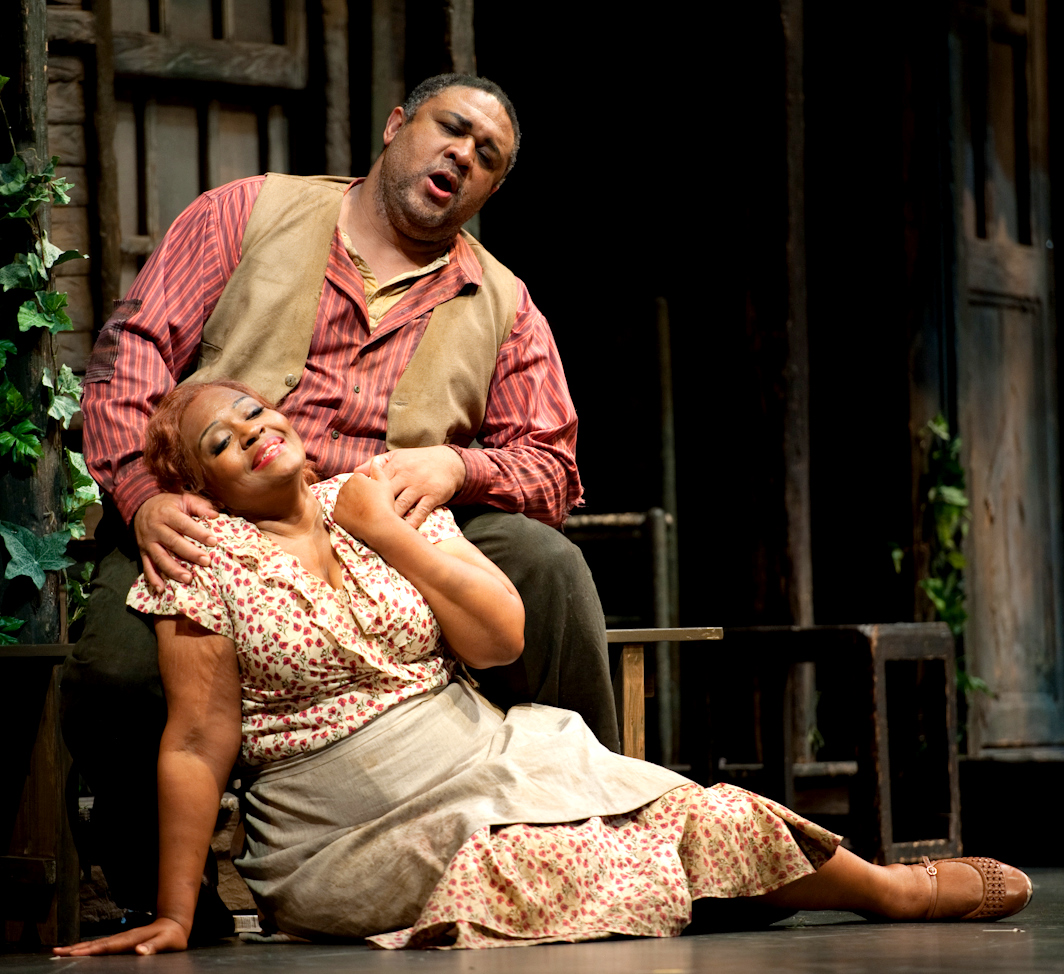
Porgy and Bess.jpgThe story of a beggar and a floozy set in a tenement on the South Carolina coast, "Porgy" has been under fire since it was written 75 years ago, with leading African-American actors and singers complaining its use of Gullah dialect and (stereotypical) black low-life characters was racist. It has a mixed record as a novel, stage play, Broadway musical and Hollywood movie, but as an opera its power is undeniable. The score has bottomless chromatic depth and complexity; its best-known melodies come to life with an organic inevitability. To name but a few: Summertime, A Woman is a Sometime Thing, I Got Plenty o' Nothin, Bess You Is My Woman Now, It Ain't Necessarily So. Stereotypes? What did a Jewish piano player from Noo Yawk know about fishermen and cotton-pickers in the Deep South? What did a Frenchman know about gypsies in a Spanish cigarette factory, or an Italian about geishas in Japan? At least Gershwin spent a summer in South Carolina assimilating the humanity beyond the stereotypes.

There is no more anti-consumerist anthem than Porgy's "I Got Plenty o' Nuttin," as modern today as ever (with lyrics updated from the opera's Gullah dialect to slightly more standard English):

I got plenty of nothing
And nothing's plenty for me.
I got no car, got no mule, got no misery.

Folks with plenty of plenty, they got a lock on the door
Afraid somebody's gonna rob them...while they're out making more
What for?

Above: Gordon Hawkins as Porgy, Lisa Daltirus as Bess. Seattle Opera photo by Elise Bakketun

This is not a condescending celebration of peasant simplicity (Marie Antoinette playing Farmville) but a ringing manifesto of minimalism. I only wish it had been delivered (by the estimable Gordon Hawkins) with more eloquence. It comes as an almost offhand soliloquy, the second number at the beginning of the second act. (Were "Porgy" a Broadway musical, it would be a first-act closer.) The poor, crippled beggar Porgy lurches across the stage on a crutch (not a goat cart), yet is never seen pleading for pennies, a man whose infirmities confer upon him not the nobility of the "noble savage" but a high ground of moral decency. Trouble is, in this production, Porgy himself doesn't command the stage; he's relegated to sideline benches while the colorfully costumed denizens of Catfish Row get good dance numbers, and the secondary roles are handled with a high level of expertise.

Mary Elizabeth Willians as Serena gives the Seattle audience the opera's best singing in her funeral lament for her husband, Robbins ("My Man's Gone Now"), murdered by Bess's no-good lover, Crown (well played by a very fit Michael Redding). It's a twist on "Old Man River" (from Showboat, 1925) that you might call Old Man River Sorrow.

Jermaine Smith makes Sportin Life a nasty snake with a redeeming smile; Gwendolyn Brown plays Mariah as Big Mamma, but in a good way; Angel Blue as Clara (who sings "Summertime" at the opening curtain) and Donovan Singletary as her huband Jake are particularly appealing young parents.

Porgy is an exhausting role, and Hawkins has been performing it for a quarter century. Ironically, he became an opera singer only after he washed out of professional baseball. A regular performer in Seattle for the past 20 years (Rigoletto, Macbeth, Tonio, Count di Luna, Gemont, etc.), Hawkins has 150 performances of Porgy on three continents under his belt, giving it everything he's got and often literally whispering his last lines (in "Lawd, I'm On My Way").

Seattle is fortunate that General Director Speight Jenkins's casting over his tenure has been resolutely color-blind. No local opera-goer bats an eye if Aida is black and Radames is white, if Macbeth is black and Lady Macbeth is white, it's all about the voices. But the license to stage Porgy and Bess comes with an inviolable condition from the Gershwin estate, which holds the copyright: all the singing parts, including the chorus, must be performed by artists of color.

Duke Ellington, who complained about "Gershwin's lampblack Negroisms" in 1935, reversed himself. "Your Porgy and Bess the superbest, singing the gonest, acting the craziest, Gershwin the greatest." he telegraphed the producer of the Broadway production.

In Seattle, a cast of African-American actors refused to perform the play during the Depression; it was envisioned as a Works Progress Administration production but was never performed. Grace Bumbry, who sang Bess at the Met in 1985, understood that the opera was more than a faded snapshot but a living piece of Americana. "Whether I sing it or not, it was still going to be there."

Gershwin himself called Porgy and Bess an American Folk Opera, yet its biggest successes have been outside the US, most notably a European tour by a South African company. "I think we've got a little jaded in the US with Porgy and Bess," Lisa Daltirus told The Times of London in 2009. But the argument over the opera's relevance is far from over. "A lot of people just think that this is a show that is lovely to listen to and happened way back when," Daltirus said. "They're not thinking that you can still find places where this is real."

Daltirus, whose steely Tosca at McCaw Hall in 2008 sent chills up my spine, has two lovely duets with Porgy but needs only four lines of Summertime (reprised in the opera's second half) to melt the hearts of the audience.

In the pit for this run is John DeMain, who has conducted more performances of Porgy than anyone alive. Far from running on auto-pilot, DeMain infused the opening night performance with verve and wit, from the overture's opening notes (a rocket that takes us to another world) to the rich, complex, hyperkinetic orchestrations that don't stop until Porgy hobbles off into the sunset, three and a half hours later.

Finally, the New York Times reports this weekend that there will be a new musical version of "Porgy and Bess" (a "commercial-minded reconception") opening on Broadway in December, starring Norm Lewis and Audra McDonald.

Seattle Opera presents "Porgy and Bess" through August 20 at McCaw Hall, 321 Mercer Street, Seattle. Tickets cost $25 to $241 and are available by phone (206-389-7676), at the box office (1020 John St., Seattle), or online

Monday, May 9, 2011

Magic Flute is a Highminded Fairy Tale

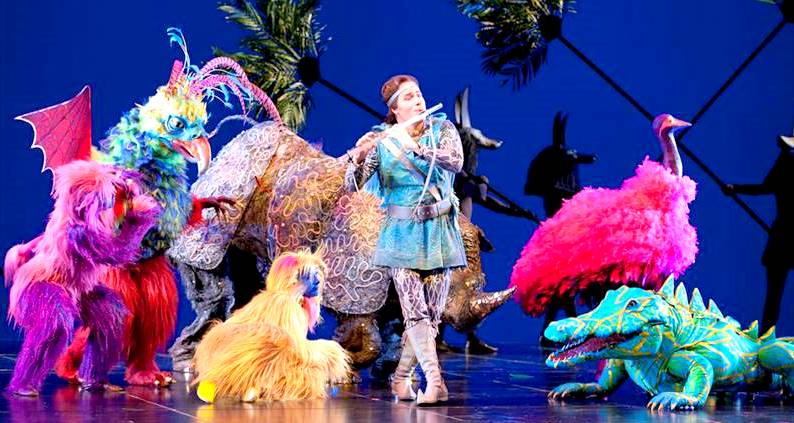
Magic Flute animals.jpg
Tamino (John Tessier) entertains a menagerie with his magic flute. Seattle Opera photos © Rozarii Lynch

Mozart's final opera, "The Magic Flute," is both a fairy tale (supposedly for children) and a morality play (supposedly for grownups). In the current production at Seattle Opera, the better part by far is the fairy tale.

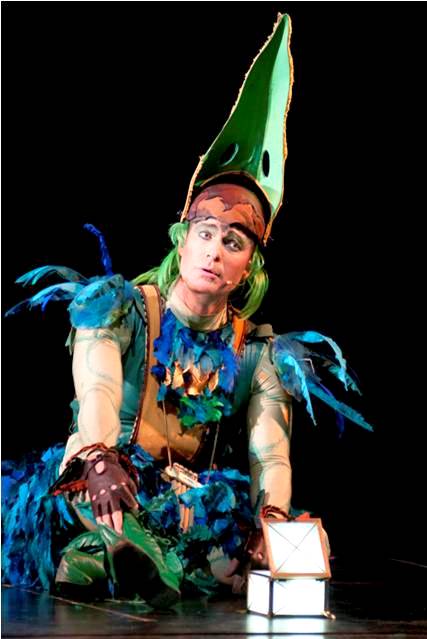
"The Magic Flute" is often described as an ideal "first opera" for newbies because some of its characters are goofy and childlike. But kids today, growing up with Big Bird, Elmo and Kermit, may not be impressed by a man in a bird suit playing a tune on the glockenspiel. It's the grownups who are, because the costumes are dazzling.

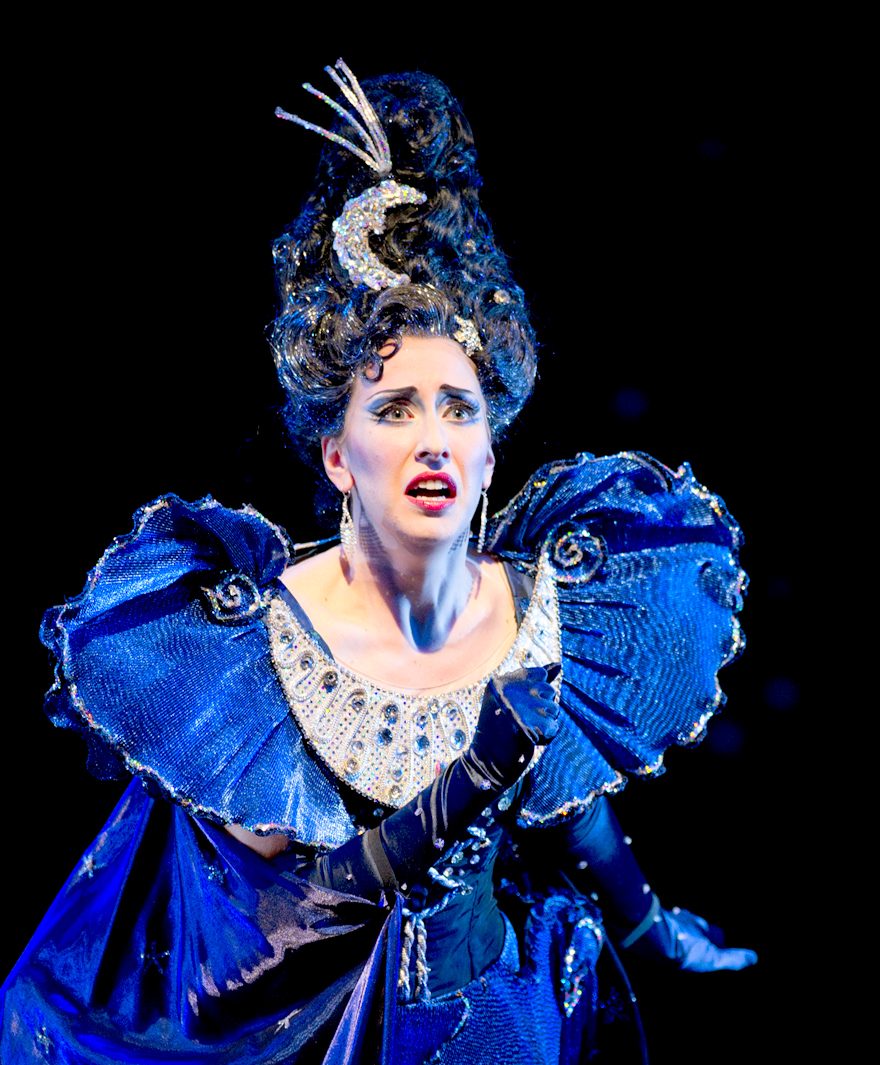
The British fashion designer Zandra Rhodes created them for a 2001 production by San Diego Opera, and updated them for the current Seattle version. The hero and heroine come off with the least interesting outfits (your basic light blue tunics), while the villains get deep purple tops and striped pantaloons. The stately good guys (and ladies) wear golden vestments that look like Flash Gordon firefighter slickers. Rhodes's cloak for the Queen of the Night is all dazzling blue and black and silver, while the three guiding spirits, in metallic, mid-thigh spandex, look like they're about to head onto the football field for Friday Night Lights. The most endearing are her costumes for Papageno and Papagena, who get to wear bird suits with beaks and tail feathers.

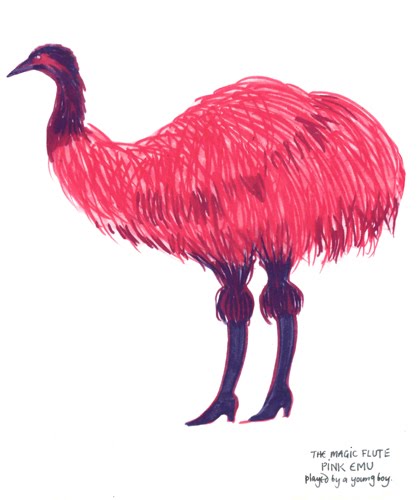
pink Emu.jpgAnd then there are the captivating animals: a fearsome Chinese dragon that wheezes its last within the first minute (it causes the hero to faint dead away before it's dispatched by the Ladies of the Night). A little later, though, a whole menagerie of beasts appears: a day-glo pink emu among an assortment of fantasmagorical birds, along with a crocodile, a rhino, and tumbling monkeys.

Queen-of-Night.jpgThe cuddly beasts make their appearance as Tamino blows a couple of test-toots on the magic flute he's been given by the maniulative Queen. Her role is sung, in the Gold cast, with great verve and clarity by coloratura soprano Emily Hindrichs, who has the vocal skills, if not the physical stature, of a menacing madwoman. On the other hand, the Russian bass (and former professional basketball player) Ilya Bannik towers over the cast as Sarastro, but doesn't have quite the resonance to be convincing as the voice of wisdom. It falls to baritone Philip Cutlip (Enrico in last year's "Lucia di Lammermoor") to provide the best singing of the night as the bird-catcher Papageno. It's the part the librettist, Emanuel Schikaneder, wrote for himself, and it's got the easiest music and the best bits of schtick as well.

Papageno.jpgFrom the pit, Gary Thor Wedow kept track of singers, players and technical effects ("Das Glockenspiel ist kaput!") with great musical aplomb, and for this production he inserted a few lines from a newly discovered libretto. But I was disappointed that one line, in particular, was excised. There's an exchange between Papageno and the wicked jailer, Monastatos, in Act One, when they first see one other, and each assumes the other is the devil incarnate. Papageno hasn't ever seen a black person, but soon reconsiders:
Es gibt ja schwarze Vögel in der Welt, warum denn nicht auch schwarze Menschen?
"There are black birds in the world, why shouldn't there be black people as well?"

It's a defining moment for the dim-witted birdcatcher, an important step in his own spiritual development. After all, why should Tamino and Sarastro get all the benefit from the Temple of Wisdom's (read "Masonic") humanism? ("In these hallowed halls, one forgives one's enemies.") Papageno, the opera's Everyman, deserves enlightenment as much as the vapid Tamino.

And vapid he is. Despite John Tessier's best vocal efforts, he's the weakest character onstage, out-acted by the baritone, outclassed by the bass, outsung by both Pamina and the vengeful Queen, and upstaged by the animals.